From writing code to assembling systems
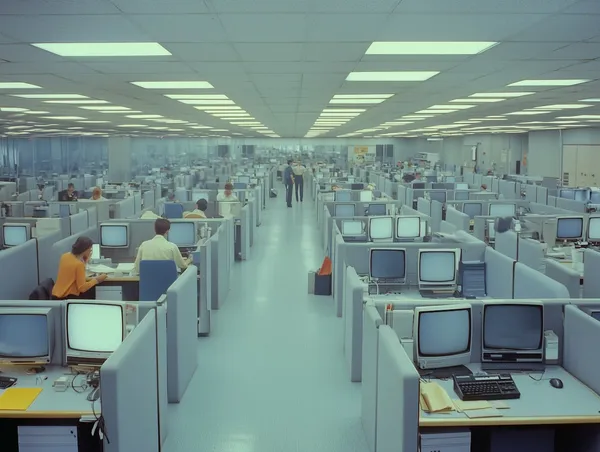
Software engineering is quietly changing. For years, developers spent most of their time writing code by hand and understanding systems through what they built themselves. As AI starts generating large parts of applications, that focus is shifting. Writing code matters less than deciding how pieces fit together.
The assembly line moment
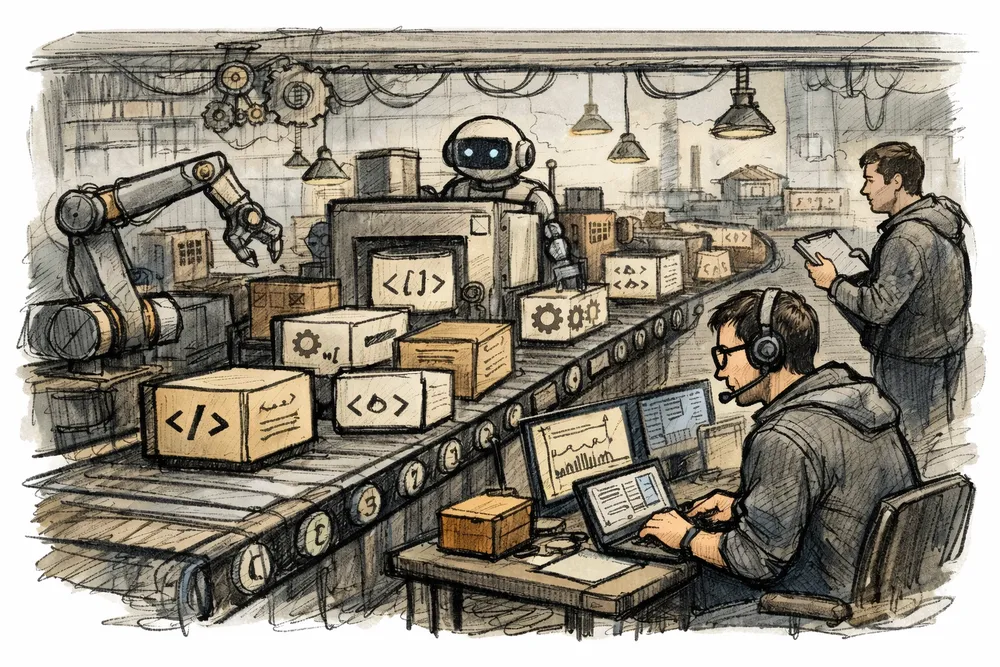
A useful way to think about this is the factory assembly line. When manufacturing adopted standardized parts, workers stopped building entire products on their own. Their job became assembling components, keeping the process moving, and making sure nothing broken slipped through. Productivity went up, but responsibility did not disappear—it changed shape.
AI-generated code creates the same situation in software. Engineers increasingly work with ready-made chunks of code: services, endpoints, queries, and helpers. The real work is connecting these parts into something consistent and reliable. Clear boundaries and predictable behavior matter more than perfect implementations.
Quality control as the core skill
Quality control becomes central. Just as assembly line workers inspect parts and stop the line when needed, engineers rely on tests, checks, and monitoring to keep AI output under control. Mistakes are cheaper to make and more expensive to miss.
In this setup, software engineers do not fade away. They become the owners of the system as a whole, responsible for keeping fast-moving, AI-generated code understandable, stable, and ready for real-world use.
Where this leads next
An open question is where this leaves software engineering in the near future. One or two years from now, teams may measure productivity less by how much code they write and more by how well they manage code produced by machines. The bottleneck shifts from typing to understanding—what was generated, why it exists, and how it behaves inside a larger system.
That points toward an integrator role. Engineers guide AI output, shape it into clear structures, and ensure it aligns with real constraints. If this trend continues, software engineering does not get simpler—it gets more abstract. The strongest engineers will be those who can turn large amounts of generated code into systems people can trust.